Welcome To
My SEA Teacher
Journey


"Education brought me to the Philippines, but the people made it feel like home"
📍Kendari..............✈️ Jakarta..............✈️ Manila................✈️ Daet 📍


About Me
Wa Ode Shifa Ayudiah Putri
Mathematics Education
Student
Halu Oleo University
SEA Teacher
Batch 11th
2026


Explore UCN - Abaño Campus

E

School Profile
Abaño Campus Laboratory School, part of the University of Camarines Norte (formerly Camarines Norte State College), is located at J. Lukban Extension, Daet, Camarines Norte, Philippines. The Abaño Pilot Elementary School, now Abaño Campus, has an area of 0.8684 hectares. It was established in 1953 and was designated the pilot school of the Division of Camarines Norte in 1959 and later became a regional pilot school by virtue of its good performance in the field of elementary education. Philanthropist Dr. Jose Abaño donated the lot. It houses the Secondary and Elementary Laboratory Schools of the College of Education and the CNSC Training Center.
Today, the campus houses the Elementary and Secondary Laboratory Schools and serves as the training center of the College of Education.The school offers Elementary and Secondary Laboratory School education while serving as a laboratory school for pre-service teachers enrolled in the College of Education. Abaño Laboratory School offers basic education consisting of elementary (Grades 1–6) and secondary laboratory school (Grades 7–10). During my SEA Teacher practicum, I conducted classroom observations and teaching practice in the Grade 8 Mathematics class. Student teachers conduct classroom observations, Assisted Teaching & Mentoring Sessions, teaching demonstration, and supervised teaching practice, allowing them to apply pedagogical theories in authentic classroom settings.


Academic Support System

Abaño Campus Laboratory School provides adequate facilities and infrastructure to support effective teaching and learning. The school has classrooms, which each classroom has a smart TV that teachers can use to present PowerPoint slides, play educational videos, and display other learning materials to make lessons more interesting and easier to understand. Every classroom also has a large whiteboard that can be used with whiteboard markers. The teacher's desk is also provided with the necessary stationery such as whiteboard marker and eraser to support classroom activities. The classroom also provided the fan to make the class comfortable for teachers and students. The school also has a library, Science Laboratory Room, sports facilities, a medical and dental office, an accounting office, a registrar's office, a Home Economics laboratory.
These facilities create a conducive learning environment for both basic education students and pre-service teachers from the College of Education who undergo professional training at the school.

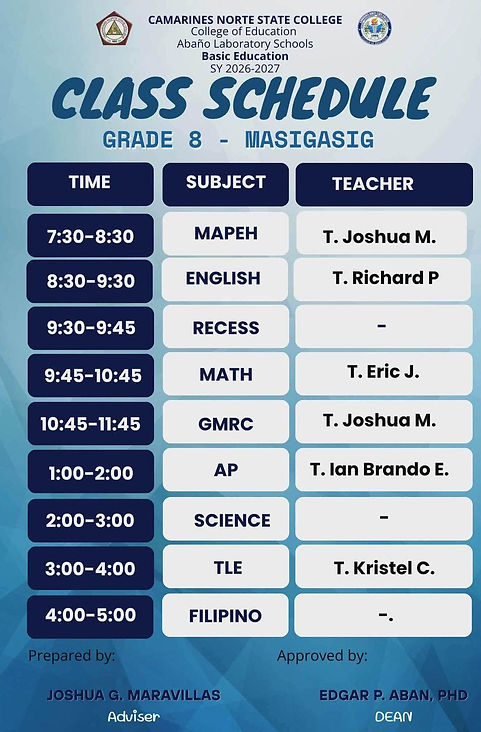
The teaching system at the Abaño campus follows a subject-specific instructional model, where each subject is taught by a teacher who is an expert in that field. Based on the Grade 8 schedule (the level where I conducted my observations and teaching), students study a variety of subjects each day: MAPEH, English, Mathematics, GMRC (Good Manners and Right Conduct), Araling Panlipunan (AP), Science, Technology and Livelihood Education (TLE), and Filipino. This schedule is implemented from Monday to Friday, which students following the same subject lineup and timetable throughout the week. Classes begin at 7:30 AM and end at 5:00 PM, with a morning recess from 9:30 a.m. to 9:45 a.m. and a lunch break from 11:45 a.m. to 1:00 p.m. Except for Mondays, they start the class at 8:00 am, because the school conducts a flag ceremony every Monday at 7:30 am before classes begins. Each subject is allotted one hour, comprising discussions, classroom activities, and assessments.
The schedule is well arranged, allowing students to study various subjects in one school day while maintaining the balance of learning experience. Different teachers are assigned to different subjects according to their field of specialization, to ensure students receive quality teaching in each field of learning.
Teaching System

Grading System
Abaño Laboratory School implements a competency-based grading system according to DepEd Order No. 8, s. 2015. Student academic performance is assessed through three main components: Written Work, Performance Tasks, and Quarterly Assessments.
Source: DepEd Order No. 8, s. 2015
This grading system emphasizes not only students' knowledge through written assessments but also their practical skills and active participation in classroom learning activities, providing a balanced evaluation of their overall academic achievement.



Cultural Profile/Practice of the Institution and Community
The cultural activities or traditions conducted in UCN Collage of Education Abaño campus are the following:
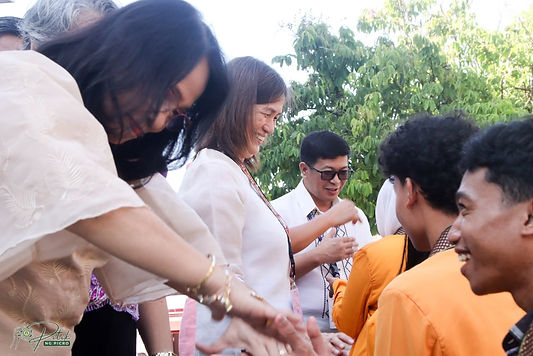
Pagmamano sa mga faculty members which is doing the bless when a faculty member approaches as a sign of respect. Also Mini MIKKS APP Humanus. The event showcased students' talents through a variety of academic, cultural, and artistic performances, while promoting the core values of Malasakit (compassion), Kamalayan sa Kultura at Sining (awareness of culture and arts), Akademya (academic excellence), Pagkakaisa (unity), and Pakikisalamuha (social interaction).
And then another activity is Buwan ng Wika which is conducted every August. In this event, there are a lot of activities, one example is "pagsulat ng baybayin" baybayin is an ancient writing system used in the phillipines long time ago, also have slogan making, poster making, and cultural dance.
Abano Campus also celebrate their united nations every november or october, and the school’s members dress up in different traditional clothing. Abano Campus also celebrate National Teachers' Month Celebration to appreciate the dedication and hard work of teachers in educating students. This celebration is filled with various activities involving students, teachers, and school organizations as an expression of gratitude and appreciation to educators. They celebrate women's national month and children national month as well. And they also celebrate Intramurals to develop students' abilities in sports, art, and teamwork. This activity includes various competitions, such as basketball, volleyball, badminton, , chess, etc.
These cultural activities help students develop not only academic ability, but also character, leadership spirit, ability to work together, appreciation for Philippines culture and tradition. These activities also create a positive school environment, so that students are encouraged to actively participate and develop both personally and socially.